Emergency Garage Door Repair Near Me: What Arlington Heights Homeowners Should Do First
The first fifteen minutes after a garage door emergency decide whether the situation stays manageable or turns into a security and safety problem. Most Arlington Heights homeowners make two avoidable mistakes in that window: they pull the red release cord without knowing what’s holding the door up, and they leave a compromised door hanging open overnight. If you’d rather not sort it out alone, call (877) 460-4338 and we’ll walk you through what’s safe to touch before anyone arrives.
Start Here: The Three-Sentence Answer
Stop pulling on anything if the door looks crooked, has a snapped torsion spring, or hangs at an angle. Keep people and cars out of the opening, secure the door against the floor or track with what you have, and call a specialist. That’s the short version. The rest of this post explains how to figure out whether your door needs real emergency garage door repair or can wait until morning, and how to avoid the crews that prey on homeowners who call at the worst possible moment.
Why the Red Release Cord Is the First Thing You Should Not Touch
The emergency release cord on a garage door opener is designed for one purpose: unplugging the door from the opener so you can lift it by hand when the power fails. What it does not do is lift the door. That job belongs to torsion or extension springs, and when a torsion spring is broken, the door’s full weight is being held only by the cables and the track. Pull the cord in that state and the door can drop hard and fast if the cables are even slightly compromised.
A standard residential garage door can weigh hundreds of pounds. The spring is the counterbalance. Remove the counterbalance and the door is a heavy slab riding on two thin steel cables.
What to do instead:
- Leave the release cord alone until a technician confirms the springs and cables are intact.
- If the opener is non-functional but the door is down, you don’t need to release anything. The door is already at rest.
- If the door is stuck open with a broken spring, don’t pull the cord and don’t force it shut. Match the problem to an emergency call, not a YouTube tutorial.
We’ve worked enough spring failures across Craftsman and Raynor systems in Arlington Heights to see how often the cord gets pulled first. It’s the single most common mistake homeowners make, and it’s the one most likely to put someone in the hospital.
Is the Door Safe to Leave in Its Current Position, or Does It Need to Be Secured Right Now?
Get out of the car. Stand outside the garage at a safe distance and look at three things: the position of the door, the condition of the cables, and whether the door sits level across the opening. The assessment below takes about two minutes and tells you whether you’re looking at a wait-until-morning situation or a secure-it-now situation.
Secure it now (do not leave it):
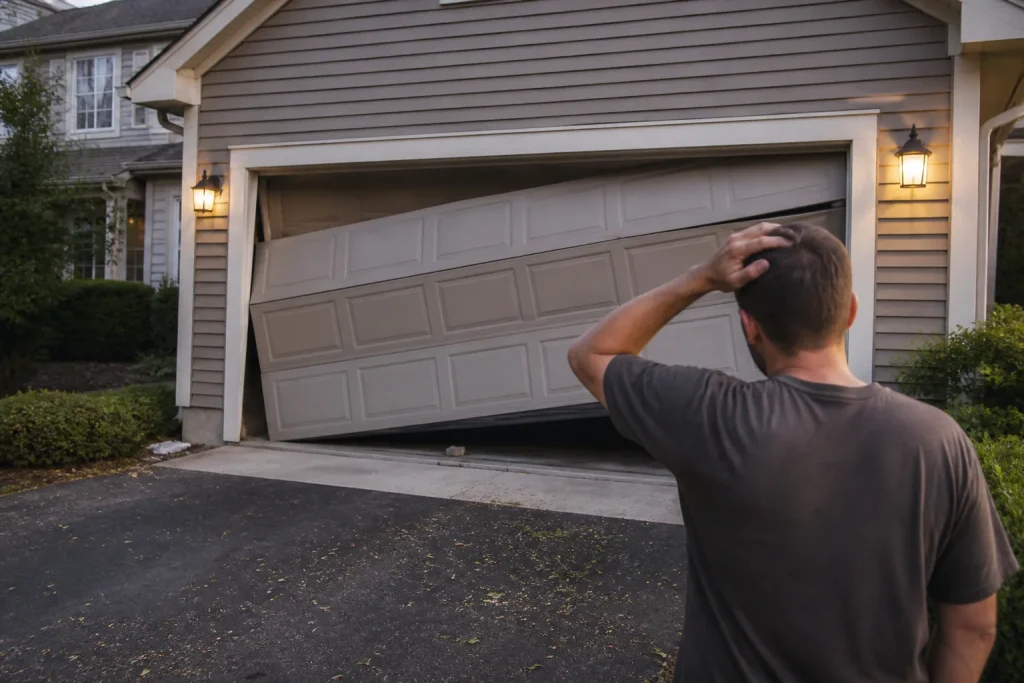
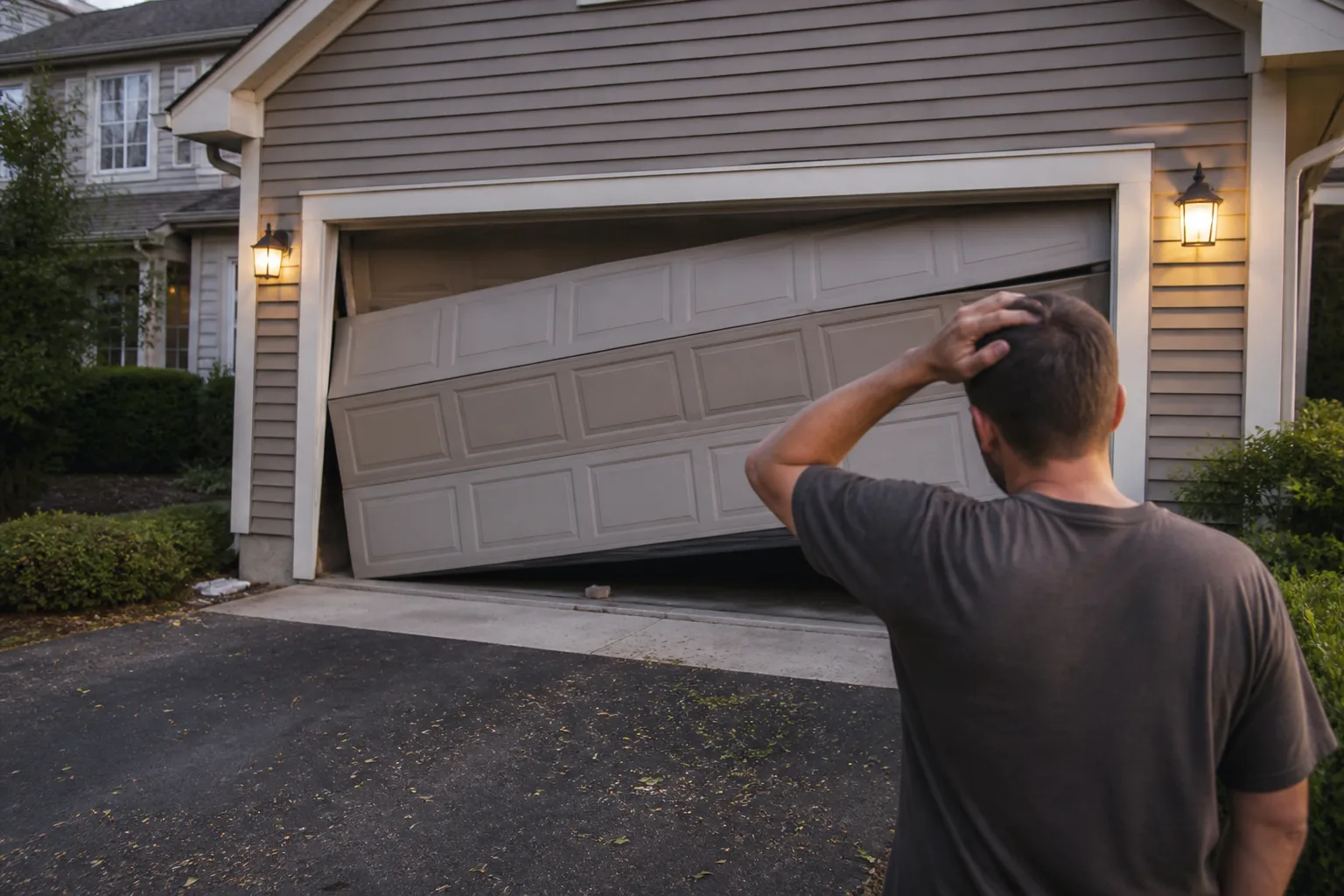
- The door is partially open and tilted. The track has lost its geometry, and the door can slip further.
- A torsion spring is snapped and the door is held up only by the opener motor.
- You can see frayed or slack cables on either side.
- The door has come out of the track entirely on one side.
Safe to leave in place until a scheduled visit:
- The door is fully closed and won’t open. You’re locked in or out of the garage, but nothing is hanging.
- The opener runs but the door doesn’t move, and the door is at rest on the floor.
- A remote or wall button has stopped responding but the door itself is down and untouched.
If you’re in the second category, you can schedule a normal appointment. If you’re in the first, an Arlington Heights crew needs to secure the door, and letting it sit overnight isn’t smart.
How to Manually Lock a Garage Door From Inside When the Opener Is Dead
When the opener stops working and the door is already closed, the goal is to keep the door from being lifted from the outside. Most residential garage doors have one of four locking options, and they’re all quick to engage from inside.
- Slide bolt lock (manual): Most panel-style doors have a slide lock on one or both vertical tracks, mounted about a foot above the floor. Slide the bolt into the hole in the track and it’s locked.
- Automatic opener lock: Many newer LiftMaster and Chamberlain openers engage a deadbolt automatically when the door fully closes. If the door is closed and the opener is powered, the deadbolt is likely engaged. If the opener lost power, check the manual release mechanism on the opener rail.
- Vise grips on the track: A pair of locking pliers clamped onto the track just above a roller (with the door down) will prevent the door from being lifted. This is a temporary fix, not the pattern to live with.
- Bar or pipe through the track: A length of pipe or a sturdy bar pushed through the track’s perforations on both sides (if the door has a track style that allows it) will block door travel. Only do this with the door down.
Whichever method you use, do it from inside the garage with no one standing under the door. Then walk out through the interior door and get the system repaired before the door needs to move again.
What Counts as an Emergency Garage Door Problem (and What Can Wait Until Morning)
Half the calls we field at odd hours turn out to be jobs that could have waited safely until the next day. The other half are real risks that shouldn’t. Here’s the honest split.
Real emergencies:
- Broken torsion spring under tension. A snapped spring means the door is being held by opener and cables alone. Don’t touch it, and don’t let the door run.
- Door off the track. The door can drop or swing unpredictably. Secure the area, keep everyone clear, and call.
- Security breach. The door is stuck open and the garage or house is exposed. That’s a same-night call.
- Door won’t close and the home is unsecured through the night. This lands in the emergency column for security reasons, not mechanical ones.
Can wait for a scheduled visit:
- Opener makes noise but the door is fully closed and secure.
- A remote or keypad stopped working but the wall button still does.
- Cosmetic panel damage that doesn’t affect travel or weather sealing.
- One section of a multi-door system is off, and the others are working.
Deciding which category you’re in honestly matters. Every real Arlington Heights emergency garage door call has to be handled with the right parts on hand, and pre-staging parts takes planning.
Red Flags in Emergency Dispatch Calls
Predatory operators know homeowners in a panic are less likely to ask questions. Learn the patterns before you call.
- “We’re nearby right now and can be there in fifteen minutes.” A real specialist needs to know what’s wrong before promising an arrival window. Too-fast promises often mean a subcontractor being routed through a call center.
- A live answering service that can’t answer a single technical question. Ask what a torsion spring is. If the person on the phone doesn’t know, you’re not talking to a garage door specialist.
- No written estimate before work. A specialist quotes before touching the door, especially for spring repair, which is the most safety-critical and mechanically complex job in the trade.
- Pressure to sign something on the spot. A legitimate quote is a quote, not a contract signed under duress.
- Quoted price that grows once the door is apart. Ask up front: “Is this the price for the whole job, or could it change once you see it?”
You have time to ask these questions even in an emergency. Take it.
What to Have Ready Before You Call
The more a technician knows on the phone, the better the odds the right parts are in the vehicle when they arrive. Have these five facts ready:
- Door brand. Clopay, Amarr, Wayne Dalton, and Raynor handle differently, and each needs matching parts.
- Opener brand and age. LiftMaster, Chamberlain, Genie, and Craftsman all have their own diagnostics. A legacy Craftsman chain drive and a modern LiftMaster Wi-Fi opener are diagnosed differently.
- Spring type visible. Torsion springs (horizontal shaft above the door) or extension springs (two springs running along the side tracks). The repair is entirely different.
- Was the door in motion when it failed? “It was going up when it stopped” narrows the diagnosis significantly.
- Did the door move at all after the failure? A door that’s completely immobile points one direction. A door that slipped and stopped points another.
We work on these brands directly, so a Craftsman opener on a ten-year-old Clopay door is a combination we’ve already seen. Knowing the setup before arrival is what keeps a real repair from turning into a two-trip return.
When to Call a Pro
If a torsion spring is broken, the door is off the track, or your home is exposed while the door sits stuck open, call a pro now. Spring repair and off-track repair involve high tension and heavy moving parts. Getting this right means turning off the opener, securing the area, and letting a trained technician handle the load. Our technicians have up to 9 years of experience with these systems, and we handle spring, opener, panel, and full-door work under one roof.
If the door is down and secure and you can wait, schedule a normal visit and get it fixed properly. Either way, a written estimate comes before the work starts. Call (877) 460-4338 for a free estimate.
The Bottom Line
The 15-minute window after a garage door failure comes down to three steps: assess the door’s position, secure it where you can, and call a specialist who knows the brands under your roof. Don’t pull the release cord without knowing what’s holding the door up. Don’t leave a compromised door hanging open overnight. And don’t sign anything that didn’t start as a written quote.
If you’re in Arlington Heights and need help, Arlington Heights Garage Door Repair Pros offers free estimates. Call (877) 460-4338.
Related Services in Arlington Heights
If your failure turns out to be a broken opener rather than a broken spring, start with garage door opener repair. If the spring is the culprit, garage door spring repair is the right call, and it’s the service we treat as a specialist-level job. For everything else, from panel damage to off-track repairs, garage door repair covers the mechanical work, and the team at Arlington Heights Garage Door Repair Pros can route you to the right person.
What happens when you call
- 1
A real person answersNo phone trees – you reach a local pro.
- 2
You get an upfront price rangeHonest numbers before anyone is dispatched.
- 3
A background-checked tech heads outLicensed & insured, dispatched right away.
- 4
You approve before work beginsNothing starts until you say go.
Frequently Asked Questions
No. Don’t force a door with a broken torsion spring open or closed by hand, because the door’s full weight is no longer counterbalanced and it can drop or slam unpredictably. Keep everyone clear, leave the opener off, and call for emergency service so the door can be secured properly.
Emergency garage door repair in Arlington Heights typically falls into two ranges: opener diagnostics and repair usually run in the low two hundreds, and spring repairs (single spring) run in the two-hundreds to low three-hundreds depending on door size and spring type. Matched spring pairs cost roughly double, since both springs are usually replaced together. Extra charges apply for emergency response, and everything is quoted and agreed before work begins. Call (877) 460-4338 for an exact quote, and estimates are free.
No. We quote the job in writing before any work starts, and the written estimate is the price. If a technician finds something additional during the repair, you get a revised quote and decide before anything else is done.
Yes. The local pros we connect you with are licensed and insured as their state requires, and they work on the major garage door brands, including LiftMaster, Chamberlain, Genie, Clopay, Amarr, Wayne Dalton, Craftsman, and Raynor. If your brand isn’t on that list, ask when you call.
Written by the team at Arlington Heights Garage Door Repair Pros.
Need Garage Door Help?
Call Arlington Heights Garage Door Repair Pros - the local pro we connect you with is licensed and insured, here with fast after-hours help in Arlington Heights.
(877) 460-4338